Tesla Stock, SpaceX IPO & Starship V3: Elon Musk Week
SpaceX filed its IPO S-1, Starship V3 left the pad and mostly came back, and TSLA is sitting at $426 like it has somewhere important to be. Oh, and a guy drove his Cybertruck into a lake because Elon said it could. Happy Memorial Day weekend, everyone — we’ve got a lot to unpack.
📈 TSLA at a Glance
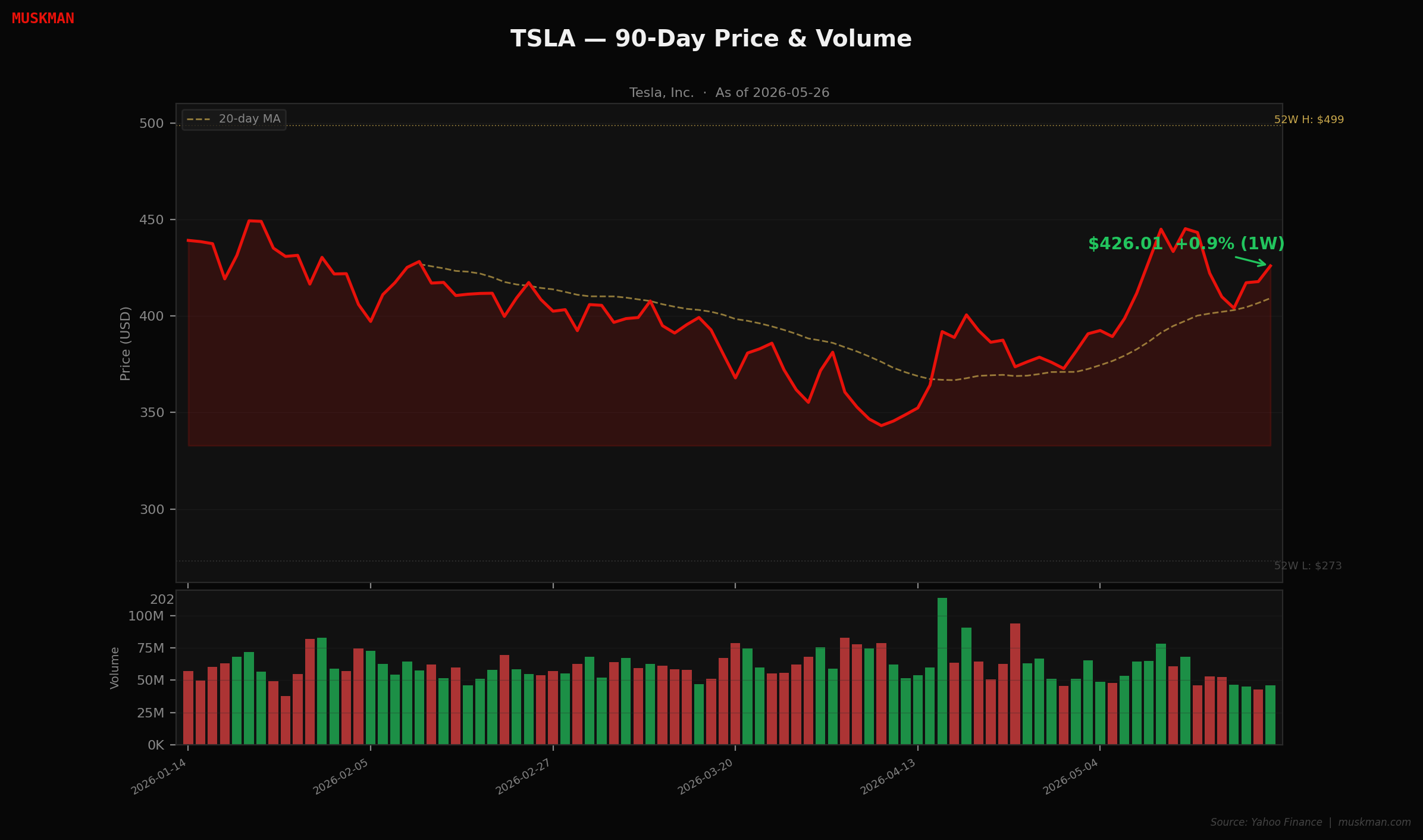
↑ TSLA price (red line) + volume (bars) — 90-day view. Source: Yahoo Finance.
TSLA closed at $426.01 on May 26, 2026 — up 1.95% on the day, up 0.89% on the week, and up a very respectable 13.99% over the past month. The market cap sits at a cool $1.60 trillion, which is the kind of number that makes index fund managers sweat in their sleep.
Now, let’s be honest about the full picture, because we promised receipts: TSLA is down 2.75% year-to-date and trading at a P/E ratio of 383.8. Yes, 383.8. That’s not a typo. That’s the market saying, “We are not buying a car company, we are buying a religion, and the tithe is a 383x earnings multiple.” Value investors have left the chat.
The glass-half-full read: TSLA is sitting at roughly 67.7% of its 52-week range (low: $273.21 / high: $498.83), meaning there’s meaningful room to run back toward all-time territory. The analyst consensus target sits at $411.89 — which means, at current prices, TSLA is already trading above the mean target. The optimists on the Street have a high target of $600, and 41 analysts are covering the name, so the argument is alive.
- 1-Week Peer Check: NIO got absolutely cooked (-14.8%). Rivian had a solid week (+3.1%). Lucid continues its slow shuffle (-3.3%). TSLA’s quiet +0.89% looks positively dignified by comparison.
- Technicals: The month-long +14% move suggests momentum, but that P/E demands flawless execution. Any robotaxi slip, any FSD delay, and the multiple gets questioned loudly. We’re watching $410 as near-term support and $450 as the next resistance level worth respecting.
- Bottom line: The stock is consolidating after a strong month. Which is analyst-speak for “nobody knows what’s next but we’re cautiously optimistic and also sending it.”
📰 The Musk Digest
Five stories you need to know before you touch that Memorial Day hot dog:
1. SpaceX drops its IPO S-1 — and Tesla’s “Terafab deal” is apparently not a done deal. SpaceX filed its S-1 prospectus with the SEC this week ahead of what is shaping up to be one of the largest IPOs in history. Buried in the 308-page document, however, is some cold water for TSLA bulls: the legal language around the Tesla-SpaceX Terafab collaboration and other much-hyped synergies is, per the filing, far from finalized [2]. Elon has been talking up Tesla-SpaceX manufacturing synergies for months. The S-1 says: “not so fast, buddy.”
2. Starship V3 launches — mostly successfully. SpaceX launched the first Starship V3 on May 22 after a one-day scrub, completing most of its suborbital test objectives [11][12]. The bad news: the Super Heavy booster was lost on return [13]. The good news: “mostly successful” is a massive upgrade from earlier test flights, and the V3 is the version SpaceX needs for its Moon, Mars, and Starlink ambitions. Progress is progress, even when it involves a Rapid Unscheduled Disassembly of a very expensive booster.
3. Musk promises unsupervised FSD will be “widespread” in the US by year-end. Again. Speaking virtually at the Smart Mobility Summit in Tel Aviv, Elon said unsupervised Full Self-Driving will be widespread across the US by the end of 2026 [3]. Tesla currently operates fewer than 30 unsupervised robotaxis. This is, by our count, approximately the fifth year in a row this promise has been made. We remain cautiously hopeful and deeply familiar with the feeling of waiting.
4. FSD goes global — sort of. Tesla launched FSD (Supervised) in Lithuania, making it the second European country to approve the system [7]. Meanwhile, FSD (Supervised) also officially launched in China after years of regulatory delays [15]. Europe is moving to subscription-only pricing for new buyers [6]. The global rollout is real. It’s just slower than a car with FSD enabled in a construction zone.
5. Tesla officially buries its India factory plans. After nearly a decade of on-again, off-again negotiations, Tesla has confirmed it will not build a manufacturing facility in India [8]. India’s Minister of Heavy Industries confirmed the news. The world’s most populous country, now officially a Tesla import market. The broken promise list grows longer, and the Indian government has been quite vocal about their frustration.
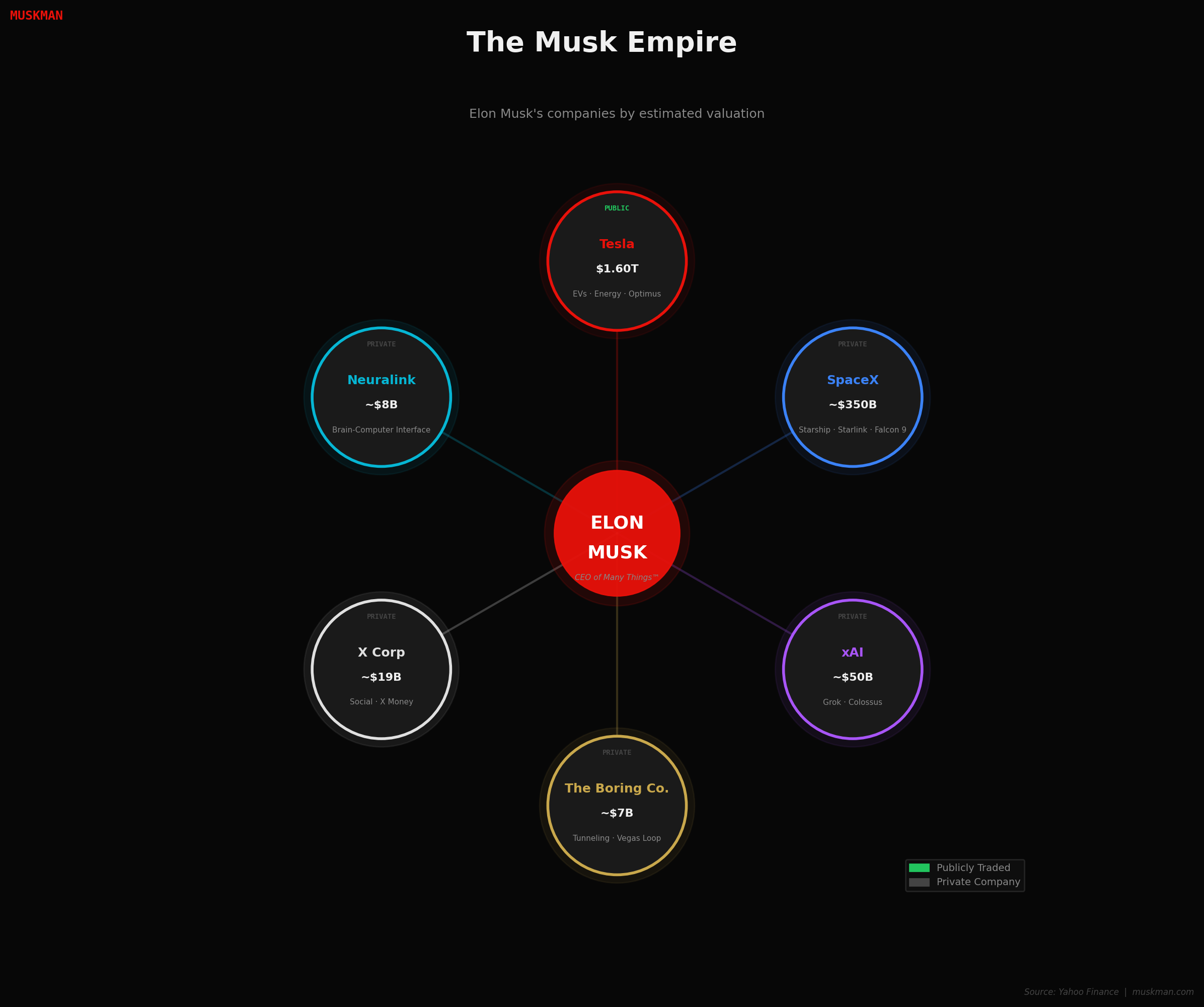
↑ The Musk Empire: all companies, estimated valuations. Public vs. private noted. Source: Muskman research.
🔬 Deep Dive: The SpaceX IPO S-1 and What It Means for Tesla
Let’s talk about the biggest financial document to hit the SEC’s servers in years. SpaceX filed its S-1 prospectus this week [2], and if you thought it was going to be a simple “rocket company goes public” story, you haven’t been paying attention to how Elon Musk operates.
The S-1 is 308 pages of legalese, ambition, and — for Tesla shareholders paying close attention — a few carefully worded sentences that deserve a very careful read. Specifically: the Terafab deal and other Tesla-SpaceX manufacturing collaborations that Musk has been teasing publicly are, according to SpaceX’s own legal disclosures, not finalized. The company is legally required to tell potential investors the truth in an S-1. And the truth is that the synergies Elon has hinted at — shared manufacturing infrastructure, the so-called Terafab gigafactory collaboration, potential Macrohard (the rumored SpaceX-xAI compute venture) integration — remain aspirational rather than contractual [2].
This matters enormously for TSLA holders. A significant chunk of Tesla’s current P/E premium — that eye-watering 383.8x multiple — is priced on the belief that Tesla is not just a car company but an ecosystem play: robotaxis, FSD licensing, energy storage, and yes, synergistic relationships with SpaceX and xAI that create compounding value. If those synergies exist on paper but not yet in contract, the multiple gets harder to defend.
Now, here’s the bull case on the same information: SpaceX being public changes the dynamic entirely. When SpaceX is a publicly traded entity, the pressure to formalize cross-company deals increases dramatically. Public company boards have fiduciary duties. Institutional investors on both sides will push for clarity. The Terafab deal being “not done” today doesn’t mean it won’t be done in six months — it might mean it was simply waiting for the IPO process to create the right legal and financial framework to formalize it.
The IPO itself is expected to be historic. SpaceX’s private valuation is currently estimated at $350 billion. For context, that would make it one of the largest IPOs in US history at or near that valuation — competing with Saudi Aramco territory in terms of sheer scale. The company has actual revenue (Starlink alone is generating billions), actual contracts (NASA, DoD, commercial launch), and an actual product that people watch on YouTube and cheer for like a sports team.
The Starship V3 launch this week, timed almost perfectly alongside the S-1 filing, is either a coincidence or the greatest product launch / investor relations stunt in corporate history. SpaceX says: “Here’s our IPO paperwork. Also, watch this rocket.” Wall Street said: “We are listening.”
The booster loss on return is a real setback worth monitoring [13]. Starship’s economics only work at high reusability rates — the whole point is rapid, cheap access to orbit. If Super Heavy cannot reliably return, the cost structure that underpins both Starlink’s margins and any future Mars mission economics looks shakier. Ars Technica noted the V3 is “still a work in progress” [10], which is fair. But “mostly successful” on a first flight of a new vehicle version is genuinely impressive engineering, and the iterative pace SpaceX operates at means V3.1 is probably already on the pad schedule.
The bottom line: The SpaceX IPO is the story of the year. It will force clarity on cross-company relationships, create a new liquid asset for retail and institutional investors, and — if the Tesla synergies ever get formalized — potentially be the catalyst that re-rates TSLA’s multiple from “insane” to merely “very aggressive.” Stay tuned. And maybe read all 308 pages. (We skimmed them. It’s a lot.)
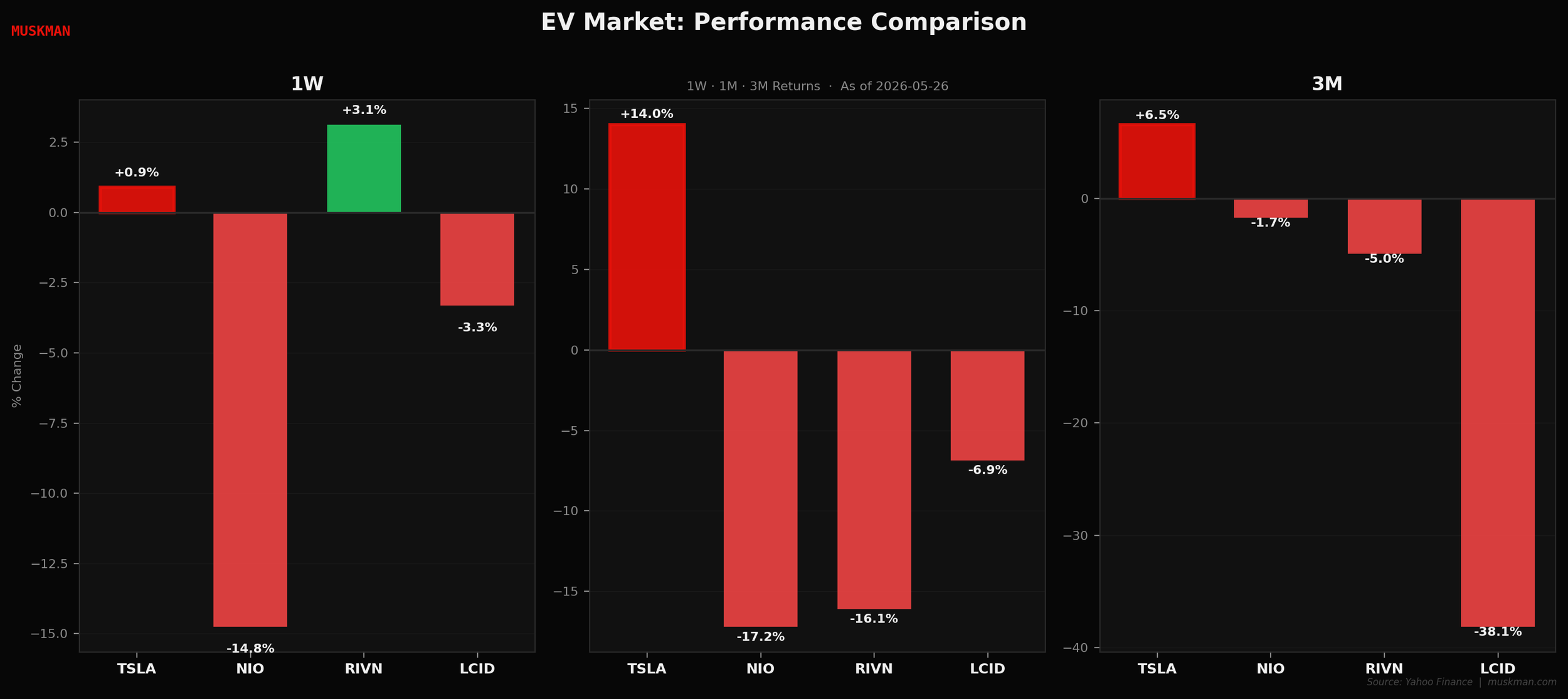
↑ EV market performance: 1-week, 1-month, 3-month returns. TSLA vs. NIO, Rivian, Lucid. Source: Yahoo Finance.
🔭 Company Spotlight: SpaceX
If you needed more proof that SpaceX operates in a different category from every other aerospace company on Earth, this week provided it in abundance. The company filed its IPO S-1, launched a new generation of its flagship rocket, lost the booster on return, and still managed to come out looking like the most exciting growth story since Amazon decided it also wanted to be a cloud company.
Starship V3: The Report Card
The first Starship V3 flight on May 22 completed most of its planned suborbital test objectives [12]. What’s new in V3? SpaceX has been tight-lipped on full specs, but the upgraded vehicle is designed for higher payload capacity and improved performance — key requirements for the Artemis lunar missions, Starlink Gen 2 mega-deployments, and the long-term Mars architecture. The loss of the Super Heavy booster on return [13] is a meaningful technical setback, but SpaceX’s test-fast culture means the lessons are already being incorporated. This is not a company that mourns hardware. This is a company that learns from it and builds the next one.
The IPO: Numbers That Make Your Head Spin
The $350 billion estimated valuation is staggering for a company that has never had a public market. But consider what’s actually inside: Starlink, the world’s largest satellite internet constellation with millions of subscribers across dozens of countries; a commercial launch business with a near-monopoly on heavy-lift capacity; NASA Artemis contracts; U.S. military launch contracts; and Starship, which — if it achieves full reusability — could reduce the cost of getting to orbit by orders of magnitude. The S-1 gives investors their first real look at the financials. Early reports suggest Starlink is the cash engine, which is a beautiful irony: Elon built a rocket company, and the thing that makes money is the internet service that runs on satellites launched by the rocket company.
What to Watch: The S-1 review process, booster recovery on V3 flights, and whether the Tesla Terafab language gets formalized before IPO pricing. The offering is expected to be oversubscribed by a factor that will make investment bankers weep with joy.
💬 The Bull Case (Opinion)
This is opinion. Not financial advice. We are a merch blog. Please consult an actual financial professional before making investment decisions.
Here’s why the next six months could be very interesting for TSLA holders, and it starts with a word: catalysts.
The SpaceX IPO is a catalyst. When SpaceX goes public at a valuation north of $300 billion, it forces a reassessment of every Elon Musk asset. Suddenly, the cross-company synergies get priced explicitly. The Terafab deal — if formalized — becomes a line item on two public company balance sheets. Tesla’s role as the manufacturing backbone for Elon’s broader empire gets a dollar sign attached to it.
The FSD global rollout is a catalyst. China launching. Lithuania live. More European countries in the pipeline [7][15]. Every market that approves FSD is a new revenue stream and a new data set that improves the system. The network effects of a global FSD fleet are genuinely non-linear.
The solar factory in Houston is a catalyst. Tesla building a 100 GW solar panel manufacturing operation in Brookshire, Texas [5] is the kind of vertical integration move that, if executed, turns Tesla Energy from a footnote into a headline. Solar plus Megapack plus grid-scale storage is a $100 billion market, and Tesla is positioning to own the manufacturing stack.
At $426 with a path to $600 if any three of these catalysts land, the bull case isn’t crazy. It requires execution. But if there’s one thing the last decade has taught us, it’s that betting against Elon’s ability to eventually deliver — even late, even messily — is a dangerous sport.
👀 Elon Did What?
Alright, we have to talk about the Cybertruck Lake Incident of 2026, which is now officially a genre of content [1].
A Tesla Cybertruck owner in Texas — apparently inspired by Elon Musk’s years of claims that the Cybertruck could function as a boat, cross rivers, and generally do things no sensible engineer would promise in a product liability environment — drove his electric stainless steel pickup truck into Grapevine Lake to test “Wade Mode.” The Cybertruck became disabled in the water. The driver was arrested [1].
We want to be clear: we do not condone driving your car into a lake. This is not a recommended product test. Wade Mode is for shallow water crossings, not recreational submarine cosplay.
And yet. And yet. Elon Musk once stood on a stage and said the Cybertruck could “traverse rivers, lakes, and seas.” He posted videos of early prototypes doing dramatic water crossings. He said it with the energy of a man who had never once consulted a maritime attorney. The internet remembered. This particular owner remembered. And now he’s learning about the difference between “marketing hyperbole” and “engineering specification” from a Texas judge.
The Cybertruck continues to be the most polarizing vehicle in automotive history. It sold. It struggled. It bounced back in sales. It has now sent someone to jail for believing in it too hard. We truly live in the timeline Elon built. If you need us, we’ll be on dry land, wearing our Muskman gear, shaking our heads fondly at all of it.
Between the SpaceX IPO, Starship V3, and a guy going to jail for trusting a Cybertruck with a body of water, this week was quintessentially Musk — visionary, chaotic, and somehow still bullish. If you’re the kind of person who watched that Starship launch with one hand over your heart and one hand refreshing your brokerage app, we have the fan gear for you. Head over to Muskman.com and rep the mission. Not affiliated with Elon Musk or any of his companies — just fans, for fans.
Shop Muskman →SOURCES & CITATIONS
- Tesla Cybertruck owner believed Elon Musk when he said it could cross a lake — now he’s in jail — Electrek, 2026-05-19
- SpaceX S-1 reveals Tesla’s Terafab deal is far from done — Electrek, 2026-05-21
- Musk says Tesla unsupervised FSD will be ‘widespread’ in the US by year-end — again — Electrek, 2026-05-18
- Elon Musk has given up on solar power (on Earth) — TechCrunch, 2026-05-23
- Exclusive: Tesla (TSLA) is building its giant solar panel factory in Houston — Electrek, 2026-05-19
- Tesla Drops One-Time Purchase For Full Self-Driving In Europe — InsideEVs, 2026-05-22
- Tesla launches FSD in second European country — Electrek, 2026-05-20
- Tesla (TSLA) officially abandons India factory after years of broken promises — Electrek, 2026-05-20
- Musk abandoned his own ‘solar electric economy’ to burn gas for an AI chatbot no one uses — Electrek, 2026-05-25
- SpaceX’s Starship V3 — still a work in progress — mostly successful on first flight — Ars Technica, 2026-05-23
- SpaceX launches Starship test flight on second try — CNBC Tech, 2026-05-23
- SpaceX launches first Starship V3 — SpaceNews, 2026-05-23
- SpaceX launches Starship V3 for the first time, but loses booster on return — TechCrunch, 2026-05-22
- SpaceX scrubs test flight of massive Starship rocket, will retry Friday — CNBC Tech, 2026-05-21
- Tesla brings ‘Full Self-Driving (Supervised)’ to China after years of delays as local EV rivals race ahead — CNBC Tech, 2026-05-21
Not affiliated with Elon Musk, Tesla, SpaceX, or any associated entities. Not financial advice.
